
Cyber Resilience Act (CRA)
for legacy device software
Assessment, planning and technical implementation – all from one partner.
For manufacturers whose software has evolved over many years.

The CRA requires capabilities that legacy device software was never designed to provide.
A software bill of materials, a secure update mechanism, a vulnerability management process and security updates throughout the support period: these are not paperwork formalities but capabilities of the software itself. In controllers, operator panels and embedded systems that have evolved over ten or twenty years, they are often missing – not through negligence, but because nobody required them until now.
Most manufacturers now know that they need to act. What is unclear is where to start and how to translate regulatory requirements into concrete software changes.
Qwasaa helps on both levels. We help you determine whether and how the CRA affects your products, and we develop an implementation plan with you. And we adapt the software itself so that it can meet the requirements.
What the CRA requires from manufacturers
The Cyber Resilience Act – Regulation (EU) 2024/2847 – applies to products with digital elements: hardware and software that is connected directly or indirectly to a device or network. As a regulation, it applies directly in all EU member states.
Manufacturers must secure their products throughout their entire lifecycle. They may only place them on the market without known exploitable vulnerabilities, must remediate vulnerabilities during the support period, maintain technical documentation and declare conformity by affixing the CE marking.
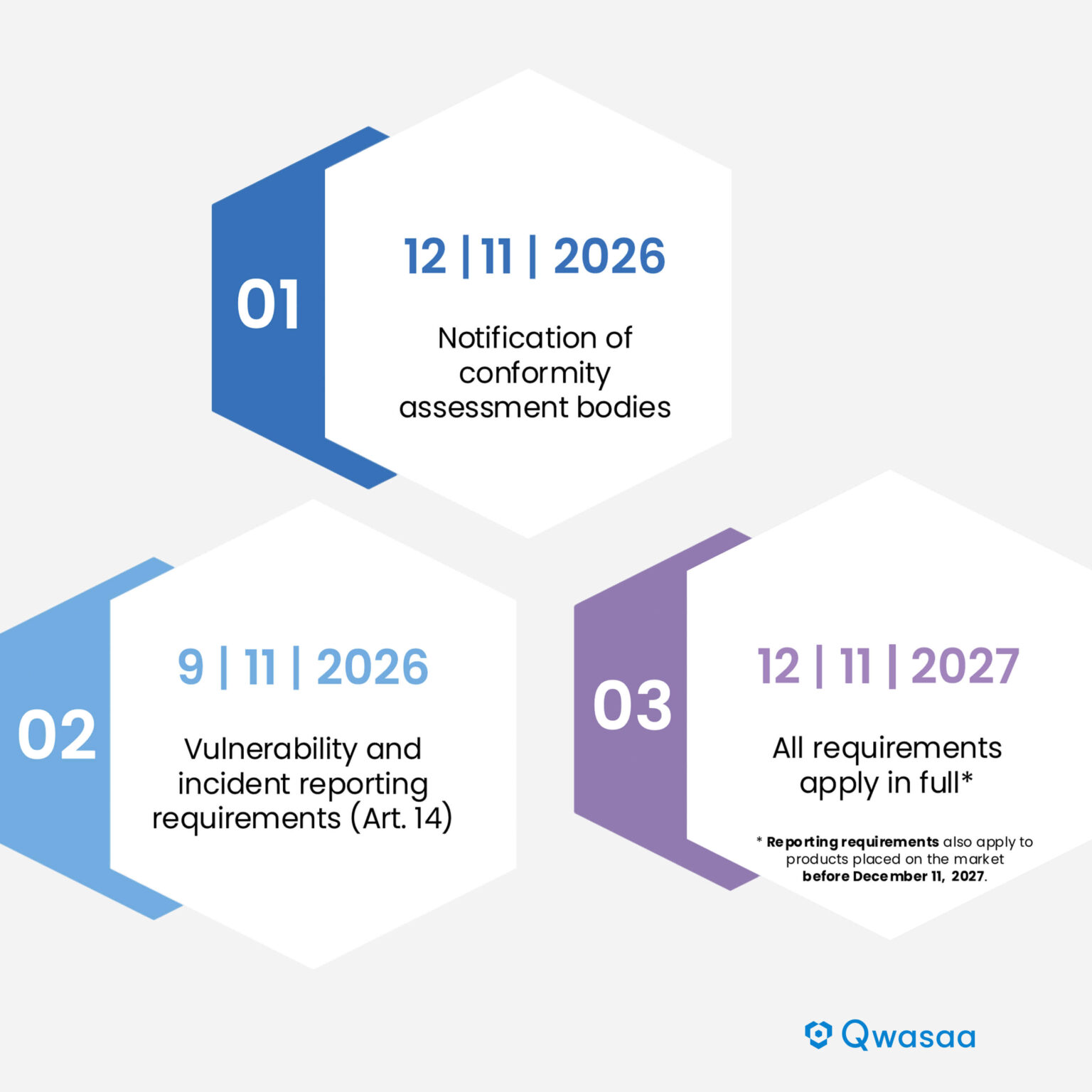
Three key dates
- 11 June 2026: The rules for notified bodies apply.
- 11 September 2026: Reporting obligations for actively exploited vulnerabilities and severe security incidents.
- 11 December 2027: All requirements apply. From then on, products placed on the market must meet the CRA requirements – their CE marking then also covers CRA conformity.
The European Commission provides a detailed overview of the Cyber Resilience Act.
Does the CRA also apply to devices that have already been sold?
At first glance, no: products placed on the market before 11 December 2027 only fall under the requirements if they are substantially modified afterwards (Art. 69(2)). For product lines that have been built and sold for years, however, that falls short – for two reasons.
The reporting obligations already apply, including to legacy devices. Since 11 September 2026, manufacturers must report actively exploited vulnerabilities and severe security incidents – explicitly also for products placed on the market before December 2027 (Art. 69(3)). Anyone with devices in the field therefore needs a way, today, to detect, assess and report vulnerabilities on time.
Every single unit counts, not the model. The requirements apply to each product at the moment it is placed on the market (Recital 38). A device model that has been built for years and continues to be sold after 11 December 2027 must meet the requirements unit by unit from then on.
For most manufacturers, the question is therefore not whether the CRA affects their legacy products, but which ones, to what extent and by when.
What the CRA means for legacy software
The regulation defines the requirements. Implementing them in a codebase
that has evolved over many years is the real challenge – and that is where we come in.
The CRA requires a software bill of materials (SBOM) in a commonly used, machine-readable format, covering at least the top-level dependencies. It is part of the technical documentation and must be provided to market surveillance authorities on request; you do not have to publish it. The effort rarely lies in the format, but in finding out what is there: copied open-source code, libraries without package management, in-house builds from earlier project phases. We establish what is actually in your software and set up SBOM generation so that it stays up to date with every build.
Vulnerabilities must be fixable through security updates, and updates must be distributed securely – without delay, free of charge and, where technically feasible, separately from feature updates. Many legacy devices have no designated mechanism for this: updates are done by a service technician, via USB stick or not at all. We retrofit an update mechanism that fits your hardware and your operations, for example with signed update packages, so that only approved software reaches the device.
Products must not be placed on the market with known exploitable vulnerabilities. Legacy software often contains components for which regular security updates are no longer available. A common example: standard support for Qt 5.15 ended on 26 May 2025; since then, only paid security patches for most Qt libraries have been available, excluding third-party components. We update or replace such dependencies step by step – for Qt, for instance, by migrating to Qt 6.
Manufacturers must test their products regularly, remediate vulnerabilities without delay, publish information on fixed vulnerabilities and provide a contact address for reports. But a patch only helps if it can be delivered quickly and without side effects. That is why we continuously match newly disclosed vulnerabilities against your SBOM and safeguard changes with automated tests – so that a security update does not itself become a risk to functionality.
The CRA sets out how the support period is determined: it must reflect the product’s expected period of use and be at least five years, unless the product is expected to be in use for less than five years. You must inform your customers of the end date, and every security update must remain available for at least ten years after its release, or for the rest of the support period if that is longer. For machines and plants that run for ten or twenty years, this becomes a technical question: can the software still be built, tested and delivered in fifteen years? We secure the build environment, toolchain and dependencies so that the answer is yes.
Products must be delivered with a secure default configuration, be resettable to their original state, protect against unauthorized access and offer as little attack surface as possible, including on external interfaces. Older devices typically contain hard-coded default passwords, open debug and service access or services nobody needs anymore. We find such weak points and close them without blocking service and maintenance in the field.
CRA assessment and implementation plan
The first question is whether and how the CRA affects your company and your products. Together with you, we capture the product scope, make a preliminary classification of your products, identify the main gaps and risks, and develop a plan for the order in which to proceed.
The starting point is the CRA Quickstart: a clear picture of your CRA readiness in just 14 days – with a structured scope assessment, a preliminary classification and prioritized gaps.
Please note: we provide a professional assessment and develop the plan together with you. This does not replace legal advice, a conformity assessment or an assessment by a notified body.

Making your software CRA-ready
The plan turns into work on the software. We adapt and modernize your device software wherever it would otherwise be unable to meet the requirements: SBOM, update mechanism, outdated dependencies, test coverage and secure default settings.
Whoever develops the plan with you can also implement it afterwards. That way, there is no gap between paper and code.
If you would first like to know where your software stands technically, a Technical Assessment is the right place to start. You can read how we replace outdated dependencies such as Qt 5 under Software Modernization, and how we safeguard changes under Test Automation.
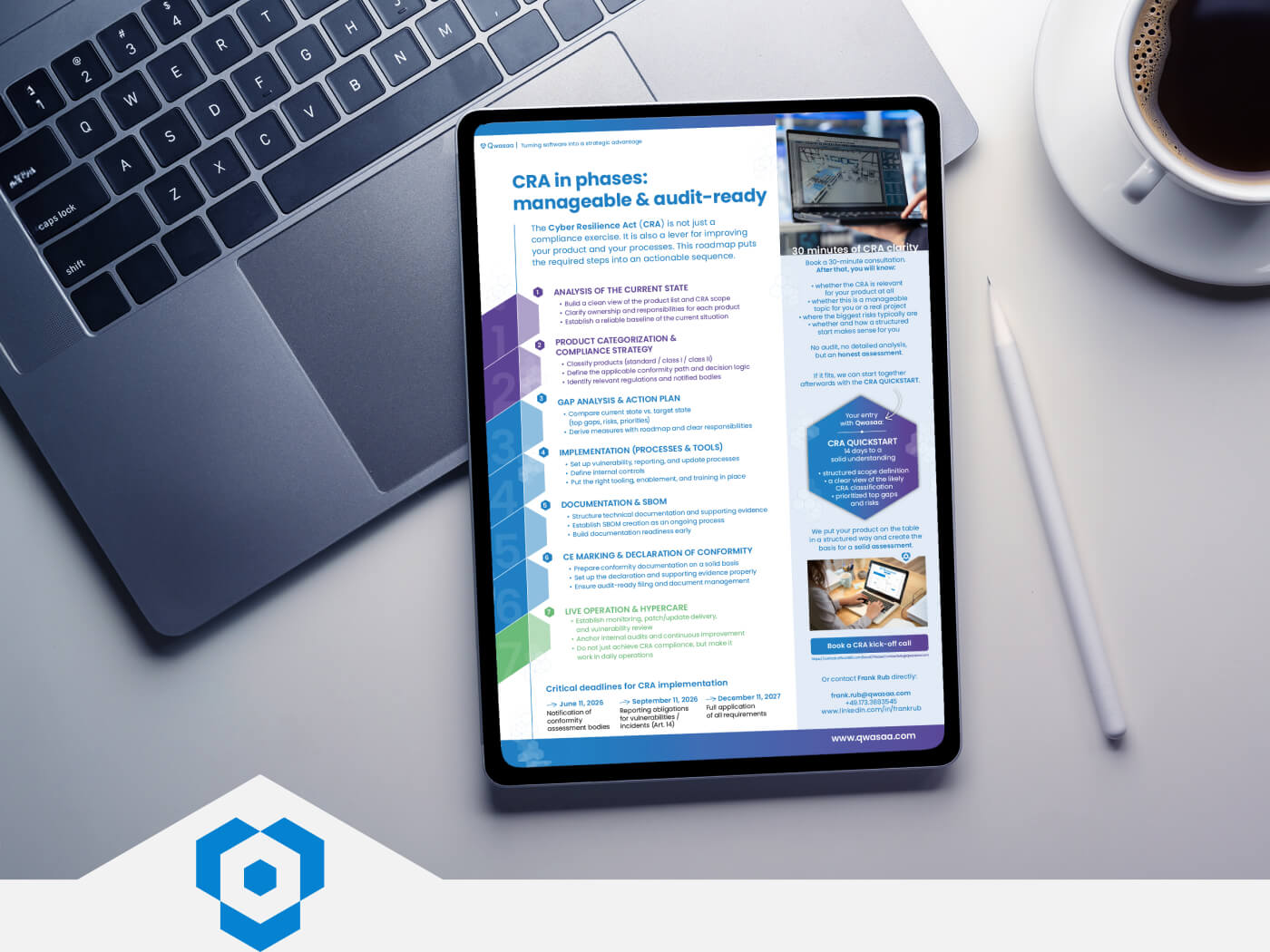
How to approach CRA compliance step by step
The CRA can be implemented in stages. Not everything has to happen at once – but some things are already due.
Record the product list and CRA scope, clarify responsibilities for each product, assess the starting point reliably.
Make a preliminary classification of products – default, important (class I or II) or critical –, define the conformity route and take other applicable regulations into account.
Compare the current and target state, prioritize the biggest gaps and risks, and derive an action plan with owners and a schedule.
Set up processes for vulnerabilities, reporting and updates, adapt the software, embed tools and training.
Structure technical documentation and evidence, establish SBOM generation as an ongoing process.
Prepare the declaration of conformity and supporting documents and file them in an audit-ready way. The conformity assessment itself lies with the manufacturer and, depending on the product class, a notified body.
Monitor vulnerabilities, provide updates, keep to reporting channels, carry out internal audits – so that CRA compliance is not just achieved but sustained.
Where to start, what can wait
Already due: a working reporting channel for vulnerabilities and security incidents, a contact address for vulnerability reports and knowledge of the competent reporting authority. The reporting obligations have applied since 11 September 2026.
Start now: clarify whether you are affected, classify your products, appoint responsible persons, start building the SBOM. By 11 December 2027: embed secure development, create technical documentation, carry out the conformity assessment.
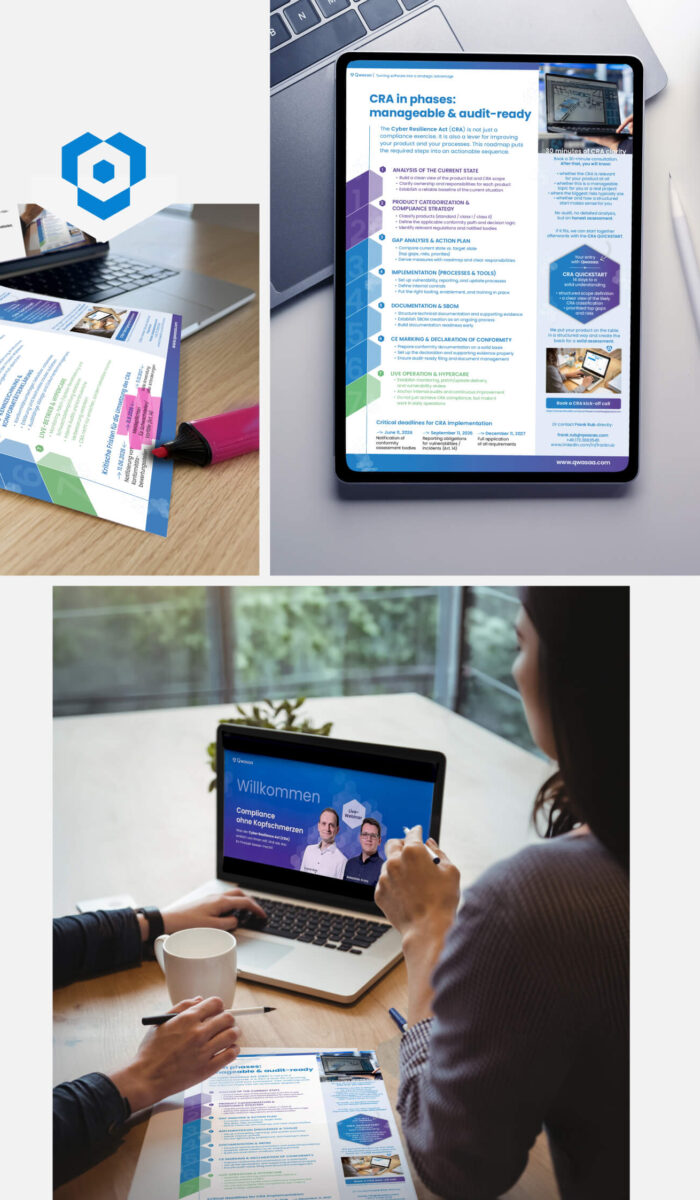
Download the CRA roadmap as PDF
Benefits beyond compliance
Done right, CRA compliance delivers benefits beyond meeting regulatory requirements. Reliable update mechanisms reduce the need for emergency fixes in the field. If you know your dependencies, you can maintain software longer and sell devices longer. Clean technical documentation becomes a reference for your own team – even when people change. And a demonstrably secure, long-lived product is a competitive advantage, especially with customers from critical industries.
Frequently asked questions about the Cyber Resilience Act
Does the CRA apply to my product?
The CRA covers products with digital elements whose intended purpose includes a direct or indirect data connection to a device or network – from connected devices and controllers to standalone software. Products covered by their own EU rules are excluded, such as medical devices, in-vitro diagnostics, motor vehicles, products certified under EU aviation law and marine equipment. Whether and how your specific product is affected is something we clarify in an initial call.
Does the CRA also apply to devices that have already been sold?
Partly. Since 11 September 2026, the reporting obligations also apply to legacy devices. For devices placed on the market before 11 December 2027, the other requirements only apply after a substantial modification – but every unit sold after that date must meet them, even if the model is older.
What has to be in an SBOM?
At least the top-level dependencies of your product, in a commonly used machine-readable format such as SPDX or CycloneDX. The SBOM is part of the technical documentation and must be provided to market surveillance authorities on request. You do not have to publish it.
How long do I have to provide security updates?
For the support period, which you determine based on criteria set out in the CRA: it must reflect the product’s expected period of use and be at least five years, unless the product is expected to be in use for less than five years. Every security update you provide must remain available for at least ten years after its release, or for the rest of the support period if that is longer.
What do I have to report since 11 September 2026?
Actively exploited vulnerabilities and severe security incidents: an early warning within 24 hours, a notification within 72 hours and a final report – for vulnerabilities no later than 14 days after a corrective measure is available, for incidents within one month. Reports go to the competent CSIRT and to ENISA.
Does Qwasaa carry out the conformity assessment?
No. The conformity assessment lies with the manufacturer and, depending on the product class, a notified body. We create the technical prerequisites and prepare the documentation together with you. We do not provide legal advice, and our work does not replace a conformity assessment or an assessment by a notified body.

30-minute CRA assessment
Book a 30-minute appointment. Afterwards, you will know:
- whether the CRA is relevant for your product,
- whether it is a manageable topic or a real project for you,
- where the biggest risks typically lie,
- whether and how a structured start makes sense.
No audit, no detailed analysis, but an honest assessment. If it fits, we then start the CRA Quickstart together.
Creating clarity together
Together, we’ll clarify whether and how the CRA affects your products, where your software stands today and what the next sensible step is.

Frank Rub
Chief Executive Officer



Sebastian Kratz
Head of Innovation
Let’s get started
We look forward to your inquiry and will get back to you within one business day.
By clicking the submit button, you confirm that you agree to our privacy policy.
You can find us here
Our home is on the 13th floor of the Jentower, in the heart of the beautiful city of Jena on the Saale River.
Do drop by – we look forward to seeing you.
show on map